Operate
Purchasing
Buying is where stock and money meet. This is the chain that takes a need for stock through a quotation, an order, a delivery and a bill to the payment that settles it — and leaves a record at each step that the stock count and the ledger agree with.
From request to settled bill
Each step is its own document with its own approval, so nothing is bought, received or paid on a verbal.
Vendors with contacts and history
A supplier record with its people, terms and every quotation, order, bill and payment against it. The statement and aged payables are read from those documents.
Requests for quotation and vendor bids
Send a request, record what each vendor quoted, and compare. A purchase proposal captures the recommended choice for approval before an order is raised.
Purchase orders
Raised from a proposal or directly, with quantities, prices and expected delivery. An order can be set to defer stock until goods are received, so the shelf is not credited for what is still on a truck.
Goods received
Book what actually arrived against the order — in full or in part. Stock is updated at the branch that received it. Where the business runs in goods-received mode, the receipt posts stock against a goods-received-not-invoiced account until the bill comes.
Vendor bills that post on approval
The bill is matched to what was ordered and received, then approved. Approval posts each line to stock, purchases or expense, input tax to its account, delivery and other charges to expense, and the total to payables.
Three-way matching, when you want it
Order, receipt and bill compared automatically on approval, with the mismatches shown. It is a per-business setting rather than always on, because a business that receives against the bill does not need it.
Debit notes and payments made
A debit note reduces what you owe for goods returned or overcharged, and reverses the stock or expense and the input tax. A payment made settles bills — allocated across them — and posts from the bank or cash account, with bank charges recorded separately.
Cost that follows the stock
Each receipt updates a moving average cost per item and branch. It is the figure the inventory valuation and cost of sales read; it is not FIFO, and it is not a landed-cost calculation.
Reports that answer the buyer's questions
Vendor Statement of Account, Aged Payables, purchase history, purchase order quantity analysis, vendor payment allocation, debit notes, a purchase tracker and a purchase tax report.
What you owe your suppliers, and for what
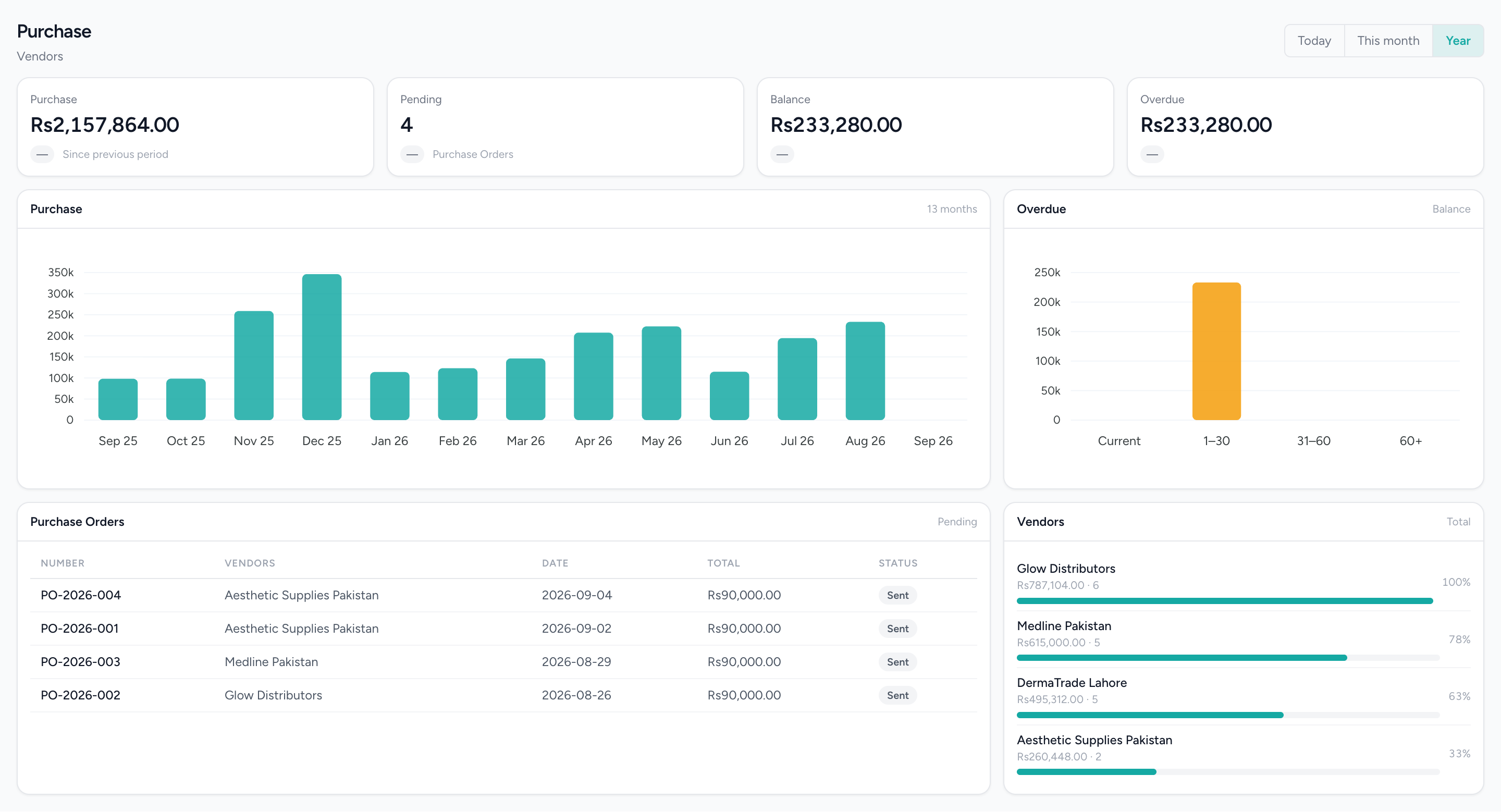
Thirteen months of supplier spend, open orders, and the balance aged into buckets so the overdue column is not a single number you have to trust.
What it does not do
Worth knowing before a demo rather than after one.
- Three-way matching and goods-received-not-invoiced accrual are switched on per business; the default is to receive and post against the bill.
- Cancelling an approved bill does not reverse its ledger entry — raise a debit note.
- Moving average cost only: no FIFO, no landed cost, no purchase-price variance account.
- The vendor statement is built from bills and payments, not from the general ledger.
- No electronic ordering to suppliers. A purchase order is a document you send; nothing is transmitted to a vendor system.
Questions people actually ask.
The answers a decision-maker needs before booking a demo.
Which purchase documents go into the accounts in IMFlow360?
Approved supplier bills, debit notes and payments made go into your accounts automatically. Purchase orders and requests for quotation don't. If goods-received mode is switched on, a goods receipt is recorded straight away and matched when the supplier's bill arrives.
Does IMFlow360 do three-way matching?
Yes, when it's switched on. IMFlow360 compares the purchase order, the goods receipt and the supplier's bill when the bill is approved, and flags any differences. It's off by default, because businesses that receive and pay against the bill alone have nothing to match.
How does IMFlow360 calculate stock cost?
IMFlow360 uses the weighted average cost of each item at each branch, updated every time stock is received. That cost drives your stock value and cost of sales. FIFO costing and landed costs such as freight aren't available yet.
What happens if I cancel a supplier bill after approving it?
The bill is cancelled, but its accounting entry isn't reversed automatically. To reverse it, raise a debit note, which corrects what you owe the supplier, your stock or expense, and the tax.
Can IMFlow360 send purchase orders to my suppliers?
Yes. IMFlow360 can email a purchase order to your supplier straight from the purchase order list, and you can also print or download it. There's no supplier portal or electronic ordering with suppliers' own systems.
Popular with
- RetailShelf, till and books that agree: barcode sales, stock, purchasing and cash control.Read more
- GroceryHigh-volume barcode selling with purchasing, transfers and reorder points behind it.Read more
- RestaurantsOrders, cash and stock that agree at close, on tills that keep working offline.Read more
- Spas & WellnessRooms and therapists booked as one, with prepaid courses on the customer record.Read more
Related capabilities
- InventoryStock that moves when a sale syncs, with goods received, transfers and reorder points.Read more
- Accounting & FinanceA real double-entry ledger: chart of accounts, vouchers, periods, and the statements that come off them.Read more
- Analytics & ReportingSales, staff and stock reports scoped to the branch you are in, and the numbers behind them.Read more
- Multi-LocationOne login, branch-scoped stock, staff and figures, and a P&L per location.Read more
Know what you bought, what arrived, and what you still owe for it.
We will show you the module on a real dataset and tell you plainly what it does not do yet. Email sales@imflow360.com or book a walkthrough.